
Acne Treatment: Inside and Out
You’ve been fighting your skin for years. The cleansers that strip it. The spot treatments that burn. The regimen you were told to be patient with, then the next one. Somewhere in there your face got tight and flaky and it still broke out.
And it keeps coming back. Something works for a while, you feel hopeful, and then you stop and it returns exactly as it was.
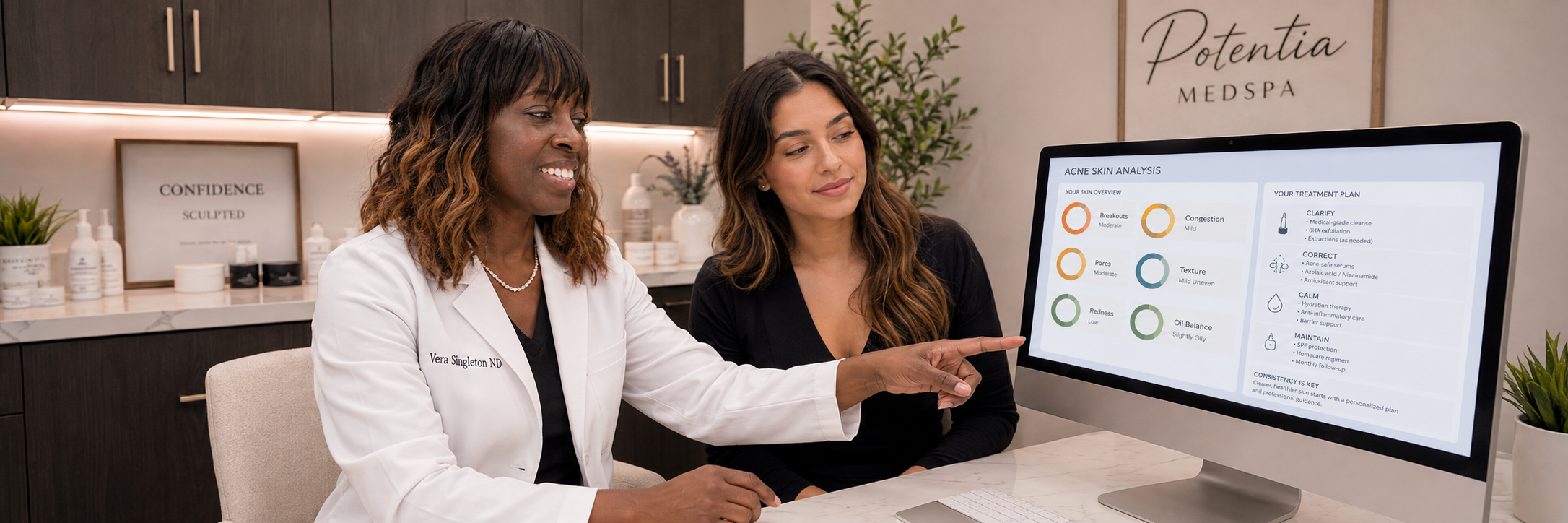
Here’s what I want you to know. Acne is inflammatory, and it’s rarely coming from one place. There’s what’s happening on your skin and there’s what’s driving it from inside, and treating only one is why it keeps returning. I start with a skin analysis, and a surprising number of women discover their skin isn’t oily at all. It’s dry, damaged, and overworked, which changes the entire approach. Then I treat the inflammation from the inside and the skin from the outside at the same time. That’s what makes clear skin stay clear.
What actually changes
| What you’re living with now | What clients commonly describe afterward |
|---|---|
| Breakouts that clear and come straight back | Longer and longer stretches of clear skin, then it holding |
| Deep, painful cysts along the jaw and chin | Fewer, smaller, and less painful when they do arrive |
| Skin that’s tight, flaky, and stripped from years of drying products | Comfortable skin that isn’t fighting you |
| A ten-step routine that isn’t working | A short routine chosen from your actual skin data |
| Redness and inflammation that never fully settles | Calmer skin overall, not just fewer spots |
| Dark marks left behind long after a spot has gone | Faded, and fewer new ones forming |
| New scarring you can see forming | Protected, because active lesions are treated rather than waited out |
| Not knowing why this is happening to you at 34 | Understanding exactly what’s driving it |
Individual results vary, and I’ll be honest with you about timelines. Skin is slow, and anyone promising you fast is not being straight with you.
Your skin might not be oily
This is where most acne treatment goes wrong, and it’s the first thing the skin analysis tells us.
Acne is treated as an oil problem almost universally. So the products strip. Foaming cleansers, alcohol-based toners, acids layered on acids, clay masks, and then a stronger version of all of it when the first round doesn’t work.
And a lot of the women I scan turn out not to be oily at all. Their sebum readings are low. Their hydration is poor. Their barrier is compromised. They have been drying out skin that was already dry, for years, on an assumption nobody ever checked.
Here’s what that does. A damaged barrier can’t defend itself, so it inflames more easily. Dehydrated skin can overproduce oil in response, which reads as oily and reinforces the mistake. And stripped skin heals slowly, so every spot leaves a mark that lingers.
So the plan can be almost the opposite of what you’ve been doing. Rebuild the barrier, restore hydration, stop the stripping, and skin calms down considerably before we’ve treated anything else.
The scan also shows me porphyrins, which is bacterial activity inside your pores. It’s invisible to the eye and it’s measured, so I can see whether the bacterial component is actually a factor for you or whether something else is driving this. That one piece of data changes the plan more often than people expect.
Why it keeps coming back
Because the inflammation underneath was never addressed.
Acne is an inflammatory condition. Treatments that work on the surface work while you’re using them, and when you stop, whatever was driving the inflammation is still driving it. That isn’t a failure of the treatment and it isn’t a failure of your discipline. It’s a treatment aimed at the visible half of a two-part problem.
Here’s what I look for.
Hormones. Androgen activity drives oil production and how your follicles behave. Adult acne along the jawline and chin, worsening around your cycle, arriving or intensifying in your thirties and forties, is very often hormonal. It responds to a hormonal approach and not to a stronger cream.
Blood sugar and insulin. Insulin regulation affects androgen activity directly. This is one of the most consistent and least discussed drivers of adult acne, and it’s testable.
Gut and food-driven inflammation. Your gut lining is a barrier. When it’s compromised, inflammatory signals reach circulation, and skin is one of the places that shows up. Food testing tells us whether something you eat daily is feeding the process, though I only run it when your history actually points there.
Nutrient status. Zinc, vitamin A pathways, omega balance, and antioxidant capacity all affect how skin behaves and how well it heals. Deficiencies here are common and almost never checked.
Stress, sleep, and everything else. Cortisol affects inflammation and oil production, and neither responds to a topical.
I test what your history points to rather than running everything on everyone. Then we treat what we find.
How I treat the skin itself
Two things I do here that most acne treatment doesn’t, and both contradict what you’ve probably been told.
I treat active lesions directly
Most practices won’t touch an active breakout. The concern is that treating it will spread bacteria or worsen the inflammation, so the standard advice is to wait until it settles and treat the aftermath.
I treat the lesion itself, with plasma energy, precisely on the spot.
And skin heals better when you do. The lesion resolves faster, the inflammation settles sooner, and the mark left behind is smaller. Waiting means a longer inflammatory cycle, and the longer that runs, the more likely you are to be left with a scar or a dark spot that outlasts the breakout by months.
This is one of the reasons people find their skin turns a corner here after years of not turning one.
Peels, monthly, formulated for acne
Chemical peels have a reputation for being aggressive, and for acne-prone skin that reputation is usually earned. Mine aren’t.
The peels I use for acne are gentle and specific to acne-prone skin, and they’re done monthly rather than every couple of months. That cadence matters. Acne is partly a problem of how quickly your skin turns over, and a gentle peel every month keeps that turnover moving consistently rather than letting congestion rebuild between appointments.
They also address what acne leaves behind. Discoloration, dark marks, and uneven tone respond to the same treatments, so you’re not waiting until the acne is fully resolved to start clearing the evidence of it.
Plasma energy for texture and tone
Beyond the spot treatment, plasma resurfaces. It improves texture, evens out discoloration, refines pores, and works on the scarring and marks acne leaves behind.
It’s also safe on every skin tone, Fitzpatrick I through VI, which matters enormously here. Post-inflammatory hyperpigmentation is one of the most common and most distressing consequences of acne in deeper skin, and many of the devices used to treat texture carry real risk of making pigment worse. Plasma doesn’t target melanin, so it doesn’t carry that risk. I monitor each case individually and use pretreatment where there’s a history of pigmentation.
A routine shorter than the one you have
After the scan, most women leave with fewer products than they arrived with. Barrier repair first, actives only where your skin can tolerate them, and a stop-doing list that’s usually longer than the start-doing one.
What treatment actually looks like
We scan first. Sebum, hydration, porphyrins, pores, tone, texture, and UV damage. This tells me whether you’re oily or dry, whether bacteria are a real factor, and what your barrier is doing. It also gives us a baseline to measure against.
We test what your history points to. Hormones, insulin and blood sugar, nutrient status, and gut or food factors where they’re relevant. Not everything on everyone.
We calm the skin before we push it. If your barrier is compromised, actives will make things worse until it’s repaired. This step gets skipped constantly and it’s why so many regimens fail.
We treat, on a schedule. Monthly peels, spot treatment on active lesions, and plasma for texture and tone as your skin tolerates it.
We address the inside at the same time. Whatever the testing showed. Nutrition based on your results, targeted nutrients, and hormone or metabolic support where a documented pattern is relevant.
We rescan. So we can see whether your porphyrins dropped, your hydration improved, and your tone evened out, in numbers rather than impressions. If the data says a plan isn’t working, I change it rather than repeating it.
On timelines. Skin turns over slowly and acne responds slowly. Expect the inflammation to settle first, then fewer new lesions, then the marks fading, in that order. Anyone offering you a fixed date for clear skin is guessing.
When you should see a dermatologist
I’d rather tell you this plainly.
If you have severe nodulocystic acne, if you’re actively scarring, or if your acne is worsening rapidly, that needs dermatology and possibly prescription-level care, and I’ll tell you so and help you get there. Early referral for scarring acne matters, because preventing a scar is far easier than correcting one.
I also work alongside dermatology rather than instead of it. Plenty of my patients are doing both, and that’s often the right answer.
What I offer that a dermatology visit typically doesn’t is the internal half: hormone, insulin, nutrient, gut, and food assessment, read alongside objective skin data, by one person. That’s the part that’s usually missing when acne keeps returning.
Acne treatment near me: why women in the East Bay come here
I check whether your skin is actually oily. A lot of women have been drying out dry skin for years.
I treat active lesions directly, which most practices won’t do, and skin heals better and scars less when you do.
Monthly peels formulated for acne-prone skin, so turnover stays consistent rather than congestion rebuilding between visits.
I look for what’s driving it. Hormones, insulin, nutrients, gut, and food, tested rather than assumed.
Safe on every skin tone, which matters because post-inflammatory pigment is one of acne’s worst consequences and many devices make it worse.
Objective measurement, including porphyrins, so we know whether it’s working rather than hoping.
I’ll tell you when you need a dermatologist, particularly if you’re scarring.
An award winning doctor with fifteen years of practice in the East Bay. I’ve bxeen voted Best Doctor of the East Bay, and I have page after page of five star reviews that show how hard I work for my patients.
I’m in Lafayette, CA, easy to reach from Walnut Creek, Orinda, Moraga, Danville, Alamo, Pleasant Hill, Berkeley, Oakland, and the broader East Bay.
Frequently asked questions
-
Adult acne is usually driven differently than teenage acne. Hormonal shifts, androgen activity, insulin regulation, stress physiology, and inflammation are the common drivers, and they tend to show up along the jawline and chin and worsen around your cycle. It’s testable, which is where I’d start rather than with another product.
-
Because a lot of the time the scan says otherwise. Dehydrated, barrier-damaged skin can overproduce oil in response to being stripped, which reads as oily and leads to more stripping. Meanwhile the sebum measurement is low and the hydration measurement is poor. When that’s what’s happening, the plan is close to the opposite of what you’ve been doing, and skin often calms considerably once the stripping stops.
-
I treat them directly, with plasma energy, right on the lesion. Most practices avoid this out of concern about spreading bacteria or worsening inflammation. In my experience skin heals better and faster when the lesion is treated, the inflammatory cycle is shorter, and the mark left behind is smaller. That’s part of why scarring is less likely.
-
Yes, and we work on both at once. The peels and plasma treatments that address active acne also address discoloration, dark marks, texture, and scarring. You don’t wait until you’re fully clear to start. That matters especially for deeper skin tones, where post-inflammatory pigment often bothers people more than the acne did.
-
Skin is slow and I won’t give you a number I can’t stand behind. What I can tell you is the order it happens in: inflammation settles first, then fewer new lesions, then the marks fade. Adherence, what’s driving it, and how long you’ve had it all affect the pace. Anyone promising a fixed timeline is guessing.
Dr. Vera Singleton, ND, MBA Founder, Potentia MedSpa, Lafayette, CA Voted Best Doctor of the East Bay Functional medicine and medical aesthetics under one roof, guided by one philosophy: one body, one doctor, simple answers.

Let’s find out what’s actually happening with your skin.
Book a consultation and we’ll start with a full skin analysis. You’ll see your own data, including whether your skin is oily or dry and what your bacterial load actually is. Then we decide what’s worth testing and build a plan that treats both halves of the problem. You’re allowed to start wherever you want. I’ll meet you there.