
Skin Analysis: Blood Work for Your Face
You have a cabinet full of products. Some were recommended by a friend, some by an aesthetician, some by an algorithm, and a few cost more than they should have.
You don’t know which ones are working. You don’t know whether the expensive one is doing anything the cheap one isn’t. And you don’t know whether the treatment you had last month actually changed your skin or just made you feel like it did.
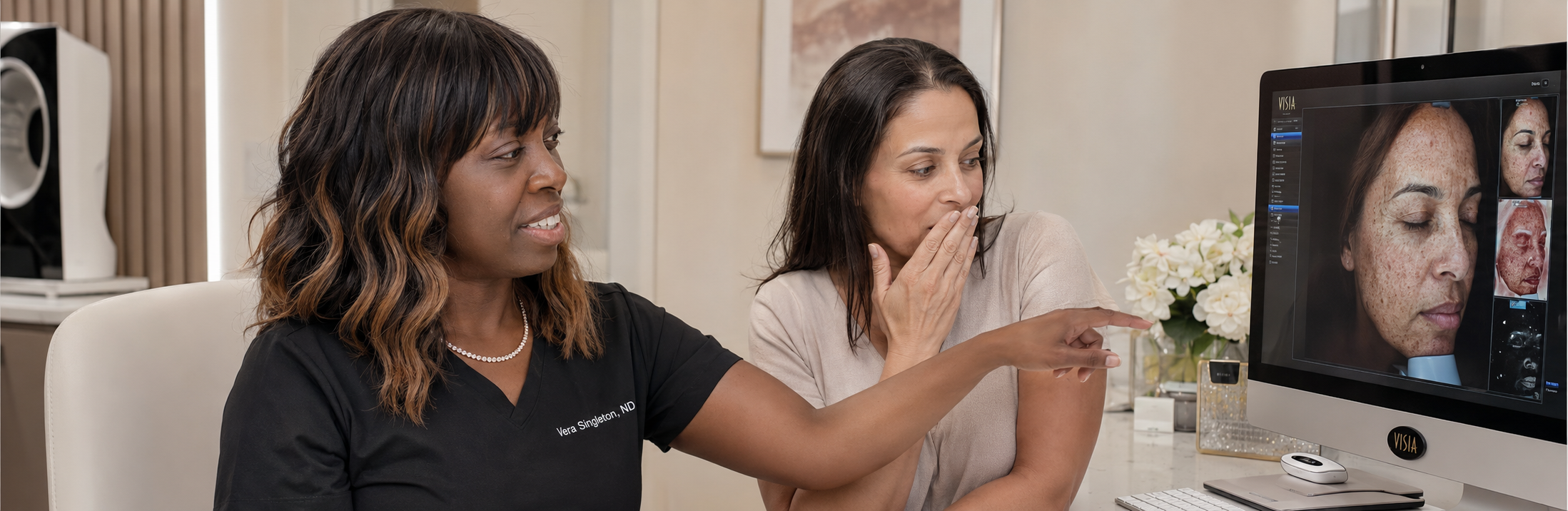
Here’s what I want you to know. A skin analysis ends the guessing. It’s high-resolution 3D imaging that shows what’s happening in your skin below the surface: sun damage you can’t see yet, pigment sorted by what’s actually causing it, pore and texture data, inflammation, and structural change. You leave knowing what your skin specifically needs, which products are worth your money, and which treatments will do something for you. Then I rescan as we go, so we’re measuring whether it’s working rather than hoping.
What changes when you stop guessing
| What you’re doing now | What changes |
|---|---|
| Buying products on recommendations and hoping | Buying the two or three things your skin actually needs, and knowing why |
| Wondering whether the expensive serum is doing anything | Knowing, because we measured before and after |
| Picking treatments from a menu | A sequence built for what your skin is missing, in the right order |
| Guessing whether your skin is improving | Numbers that either moved or didn’t |
| Being sold a package and hoping it was the right one | A protocol that gets changed when the data says it isn’t working |
| Not knowing why your skin changed after 40 | Seeing exactly what happened, and understanding what’s driving it |
| Treating your skin as separate from the rest of you | Nutrient and dietary recommendations, because skin can’t rebuild without raw materials |
| Wondering if the sun damage from your twenties matters | Seeing it, which is the moment most people change their behavior |
That last row is worth pausing on. The UV image is the one that stops people. It shows sun damage that hasn’t surfaced yet, sitting under skin that looks fine, and nobody forgets seeing it.
What the scan actually sees
I use the Image Pro Skin Imaging SUNLITE, which captures your face with multiple high-definition lenses under four different lighting conditions. Each one reveals something the others can’t.
Normal light. The baseline. What you and everyone else sees.
Parallel polarized light. Surface detail at magnification: texture, pore size and distribution, fine lines, and the actual condition of your skin’s surface.
Cross polarized light. This cancels surface reflection and looks underneath, which is where vascular patterns, inflammation, and subsurface pigment live. This is how I distinguish redness that’s vascular from redness that’s inflammatory, and they need completely different treatment.
UV light. The one that changes people’s minds. Ultraviolet imaging reveals accumulated sun damage that hasn’t yet appeared on the surface, and it’s almost always more extensive than what’s visible. What you’re seeing is what’s coming.
From those images, I get objective measurement across nine things that actually matter:
Pores
Elasticity
Wrinkles
Sebum
Skin tone
Hydration
UV damage
Porphyrins, which show bacterial activity inside your pores. This is the one nobody expects, and it’s why the scan is so useful for anyone dealing with breakouts
Skin age index
There’s also AI analysis layered on top, which processes the imaging and generates recommendations. It’s useful, and it’s a starting point rather than the answer. Which brings me to the part that actually matters.
That porphyrin reading is the reason this scan changes the plan so often for anyone dealing with breakouts. Read more about acne
Blood work for your face, and why interpretation is the whole thing
Here’s the analogy I use, because it’s exact.
If you had blood work back showing high cholesterol, you wouldn’t frame it and put it on the wall. You’d change something. Diet, exercise, a medication, and then you’d retest to see whether what you changed worked.
That’s what this is. Objective data about an organ, used to make a decision, then re-measured. The scan is the lab result. The interpretation is the medicine.
And this is where I differ from most places running this equipment. An imaging system can tell you that you have elevated inflammation and pigment. It cannot tell you that your inflammation pattern is consistent with what I see in women with gut dysbiosis, or that your pigment is following a hormonal distribution rather than a UV one, or that your poor texture and slow healing look like the nutrient deficiency I’d want to confirm with a blood panel.
I’ve spent fifteen years treating what’s happening inside people. So when I look at your skin data, I’m not only seeing a list of scores. I’m seeing which of those scores have an internal driver, which ones are purely external, and what that means for the order we do things in.
That’s why you also leave with nutritional and supplement recommendations. Not as an upsell, as a mechanism. Collagen synthesis requires specific amino acids, vitamin C, zinc, and adequate protein. If your levels are short, I can stimulate your skin all day and it won’t have the materials to build with. The scan frequently shows me that story before a blood test confirms it.
How I use it to prove treatment is working, and to change course when it isn’t
This is the part most clinics won’t tell you, so I will.
In a lot of practices, the scan happens once, at the beginning, as a sales tool. You get imaged, you get shown your worst features, and a package gets recommended. The scanner has done its job, which was to sell you something.
I rescan. During treatment, and after.
So we can see, in numbers rather than impressions, whether your pore metrics improved, whether pigment reduced, whether your texture scores moved, whether elasticity changed, and whether your skin age index shifted. Side by side, same lighting, same angles, same measurements.
And here’s the commitment that comes with that: if the data says it isn’t working, I change the protocol.
Not sell you more of the same. Change it. Different treatment, different sequence, different boosters, or a hard look at whether something internal is holding your skin back. A treatment plan that isn’t producing measurable change is information, and the right response to that information is to do something different.
I don’t know many places willing to build that into how they work, because it means admitting when a plan needs revision. I’d rather do that than keep selling you sessions.
Your products, decided by data instead of recommendations
Let me say something about the products, because this is where most women are wasting the most money.
The skincare aisle, online or at Sephora, is not built around your skin. It’s built around volume. Your friend’s holy grail serum worked for your friend’s skin. The influencer is being paid. The algorithm knows what you clicked, not what your barrier function is doing.
All of that is a recommendation. None of it is an assessment.
After a scan, the conversation changes completely. If your barrier is compromised, you need to stop exfoliating, and no amount of active ingredients will help until that’s repaired. If your pigment is subsurface and hormonal, a brightening product aimed at surface pigment will disappoint you. If your hydration measures are low, that changes which order your existing products should go on in. Where in-office treatment is the better answer than a product, read more about chemical peels
What to expect
Arrive without makeup if you can, or come a few minutes early and we’ll cleanse. Remove jewelry from the neck up.
The capture takes a few minutes. You rest your chin and forehead in position and the system captures the images. Nothing touches your skin. There’s no discomfort and nothing to recover from.
Then we sit down and go through it together, which is the part that matters. Not a printout emailed to you afterward. I walk you through what each image shows, what’s meaningful, what’s noise, and what I’d do about it in what order.
You leave with a plan. Treatment sequence, product recommendations, and where relevant, nutritional and supplement recommendations plus any lab work I’d want to see.
We rescan as we go, so progress is measured rather than assumed.
For clients working through a longer treatment plan, this is also how results are documented objectively, and it’s the measurement my Potentia Skin Progress Promise is based on.
What it costs
I’m going to be straightforward about this, because most practices won’t put a number on a webpage.
A standalone skin analysis is $100, and that includes me sitting down and interpreting it with you. The scan takes a few minutes and the conversation is the part worth showing up for.
It’s included in your initial strategy session if you’re coming in for a consultation.
And if you go on to purchase a treatment plan, it’s typically included at no charge, because at that point it’s how I build your plan and how I prove the plan is working.
See all aesthetic treatments to understand what the plan might involve, or read more about plasma treatments, which is where most plans start.
I keep it at that price deliberately. This is the front door to everything else I do, and I’d rather you have your own data than have you guessing about products for another year.
What a skin analysis doesn’t do
I’d rather set this straight than have you assume.
It isn’t a skin cancer screening. The UV imaging shows accumulated sun damage, which is a pattern of photodamage, not a lesion assessment. It doesn’t detect or rule out skin cancer. If you have a spot that’s new, changing, growing, bleeding, or not healing, that needs proper evaluation on its own terms, and sometimes a biopsy with a dermatologist. Bring it to me and I’ll look, and I’ll tell you honestly what it needs. Read more about mole and lesion removal.
It isn’t a diagnosis. It’s objective data about your skin’s condition. The diagnosis, if there is one, comes from clinical assessment, your history, and where needed, lab work.
The skin age index is a tracking number, not a verdict. It compares your skin’s measurements against a reference population, and it’s genuinely useful, because a number moving in the right direction is real evidence that treatment is working. It is not a judgment about you, and I don’t use it that way. If seeing it wouldn’t be helpful for you, we don’t have to look at it.
It doesn’t replace the conversation. The imaging tells me what’s there. You tell me what you care about. Those are different pieces of information and I need both.
Skin analysis near me: why women in the East Bay come here
I rescan to prove it’s working, and I change the protocol when the data says a plan isn’t producing results.
I read it with knowledge of what’s happening inside you, so an inflammation pattern or a pigment distribution means something more to me than a score.
You leave with nutritional and supplement recommendations, because skin without raw materials cannot rebuild no matter what I do to it.
It isn’t a sales tool here. It’s the diagnostic that determines your plan, and sometimes it tells me to do less rather than more.
You’ll probably buy fewer products, and the ones you keep will be the ones doing something.
Objective documentation, which is what my written results guarantee on longer plans is measured against.
An award winning doctor with fifteen years of practice in the East Bay. I’ve been voted Best Doctor of the East Bay, and I have page after page of five star reviews that show how hard I work for my patients.
I’m in Lafayette, CA, easy to reach from Walnut Creek, Orinda, Moraga, Danville, Alamo, Pleasant Hill, Oakland, Berkeley and the broader East Bay.


Frequently asked questions:
-
It’s high-resolution 3D imaging of your face captured under several different lighting conditions, including UV, which reveals what’s happening below the surface as well as on it. It produces objective measurements of pore size, texture, surface and subsurface pigment, inflammation, hydration, elasticity, and a comparative skin age index. The point is to replace guessing with data, both for choosing treatment and for checking whether it worked.
-
Accumulated sun damage that hasn’t surfaced yet. Pigment sitting in the deeper layers, invisible in normal light, that will eventually appear as brown spots and uneven tone. For most people it’s considerably more extensive than what they can see, and it’s the single most convincing thing in the room. It’s also not a skin cancer screening, which is a separate assessment.
-
Yes, and often the more useful answer is which ones to stop. If your barrier is compromised, actives will make things worse until that’s repaired. If your pigment is subsurface, a surface brightener will disappoint you. Most women leave with a shorter routine than they arrived with, and money back in their pocket.
-
At the start, so we have a baseline, and then during treatment to check that it’s working. For most people that means every few months while we’re actively treating, then periodically for maintenance. The comparison over time is where a lot of the value is, since a single scan tells you where you are and a series tells you whether you’re going the right direction.
-
Neither. Nothing touches your skin and there’s nothing to recover from. The capture takes a few minutes. Going through the results together takes longer than the scan does, and that’s the part worth showing up for.
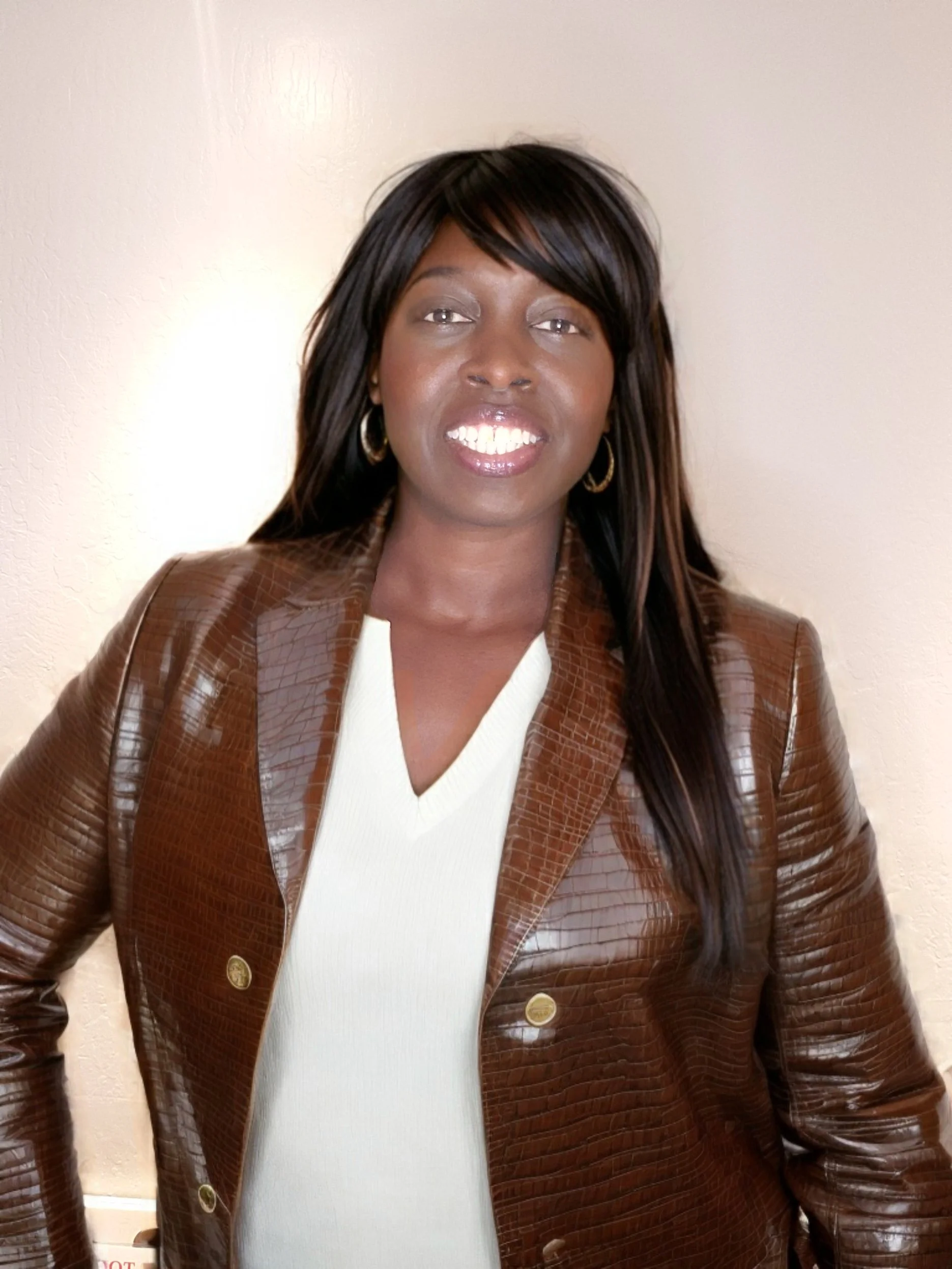
Dr. Vera Singleton, ND, MBA Founder, Potentia MedSpa, Lafayette, CA Voted Best Doctor of the East Bay Functional medicine and medical aesthetics under one roof, guided by one philosophy: one body, one doctor, simple answers.
Let’s find out what your skin is actually asking for.
Book a consultation and we’ll start with a full analysis. You’ll see your own skin the way I see it, understand what’s driving what, and leave with a plan built from your data instead of someone else’s recommendation. You’re allowed to start wherever you want. I’ll meet you there.